
A good estimate is more than a price on a page. It is a plan you can understand. When your paving company measures carefully, explains options, and documents the scope, you avoid surprises and protect the parts of your property that are hardest to repair later.
Homeowners should not need to guess what they are buying. This guide breaks down the parts of a clear estimate, what questions you should hear during the site walk, and what details should show up in writing. Use it to compare bids fairly, and to choose a scope that fits your driveway, private road, or small parking area. It also helps you spot quotes that skip base and drainage work and rely on a thin surface layer. When two bids look similar, the better one is usually the one that explains the “why.”
Site Walk: Questions Your Paving Company Should Ask
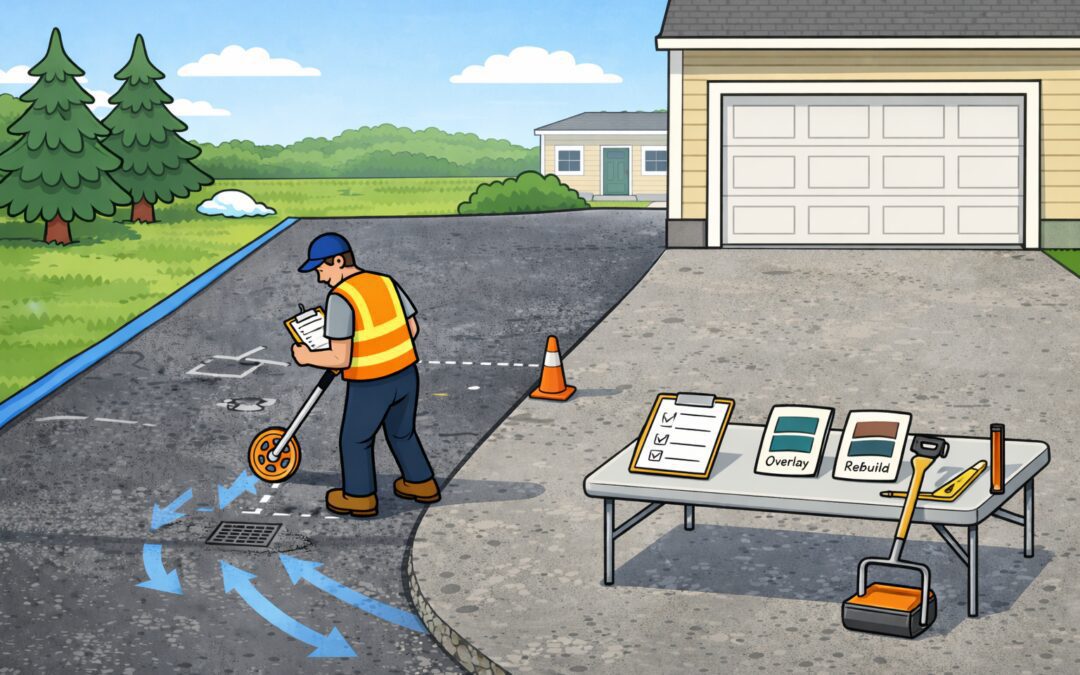
A strong estimate starts on site. Expect someone to walk the full area, not just look from the street. They should talk through how water moves today and where it should go after the work is done. In Maine, drainage is not optional. If water keeps crossing the drive or sitting at the edges, the surface will fail early.
You should also hear questions about edges and transitions. Where does the asphalt meet a garage slab, walkway, or gravel shoulder? Are there spots where plows catch an edge each winter? Is there rutting where vehicles turn, park, or stop? Those patterns tell a contractor where the structure is stressed first.
If the driveway ties into a state road, ask who handles permits and timing. MaineDOT explains the basics on its page for driveway and entrance permitting.
The Written Scope
The written scope is where estimates stop being vague. It should list what is included, what is excluded, and what conditions could change the plan. You want specifics. Does the scope include crack filling, patching, or milling, or is it only a surface coat?
If there are failed areas, the scope should say whether full-depth repair is included. That means removing weak material, rebuilding the base in lifts, and compacting each lift. A surface patch without base work can return as a soft spot.
You can also ask about the asphalt itself. What mix is being used, and why is it a fit for the site? How thick will the asphalt be when compacted? How will edges be built so they do not crumble into the lawn or shoulder? A good scope mentions compaction because compaction is what turns hot mix into a durable surface.
Certified Paving Co. states that pricing is straightforward, timelines are clear, and an owner is on site at every job. Those expectations should be reflected in the scope you receive.
Clear Pricing and Options
Good estimates let you compare options without pressure. Most residential projects have at least two paths: a full rebuild, or an overlay on a stable base. A clear estimate explains why one is recommended and what tradeoffs come with the other. If the base is soft, if the edges are collapsing, or if the drive holds water, an overlay may look good for a season and then crack again.
A responsible paving company will separate essentials from add-ons. For example, a quote may include base repair in specific areas, then list add-alternates like widening, adding a gravel shoulder, resetting drainage structures, or adjusting an apron for easier plowing. When options are separated, you can protect the core quality of the job and control the budget. It also makes bids easier to compare because you can see what is actually included.
What Good Paving Looks Like
When you read an estimate, picture the finished surface. Good paving is consistent. The driveway should have a stable profile that sheds water, edges that are supported, and transitions that do not create a hard bump at the garage. In the plan, look for grading and base repair where needed, plus a compacted lift that matches the use of the area.
Quality also shows up in the details contractors do not always spell out. The crew should place the mix evenly and compact while the mat is still workable. Roller timing, joint tightness, and clean edges all matter because they reduce the places where water can get into the pavement.
Joints matter, too. On a wider driveway or private road, you want clean joints that are tight and straight, not ragged seams that invite water. On tight residential sites, you want careful work around drains, slabs, and stone borders. If a quote mentions only a surface layer but ignores low spots and ponding, treat it as a warning sign.
Schedule your walkthrough
Ready for an estimate you can compare? Review our Residential Paving and Commercial Paving pages, then contact us to schedule a free in-person walkthrough and written scope. We bring four generations of