
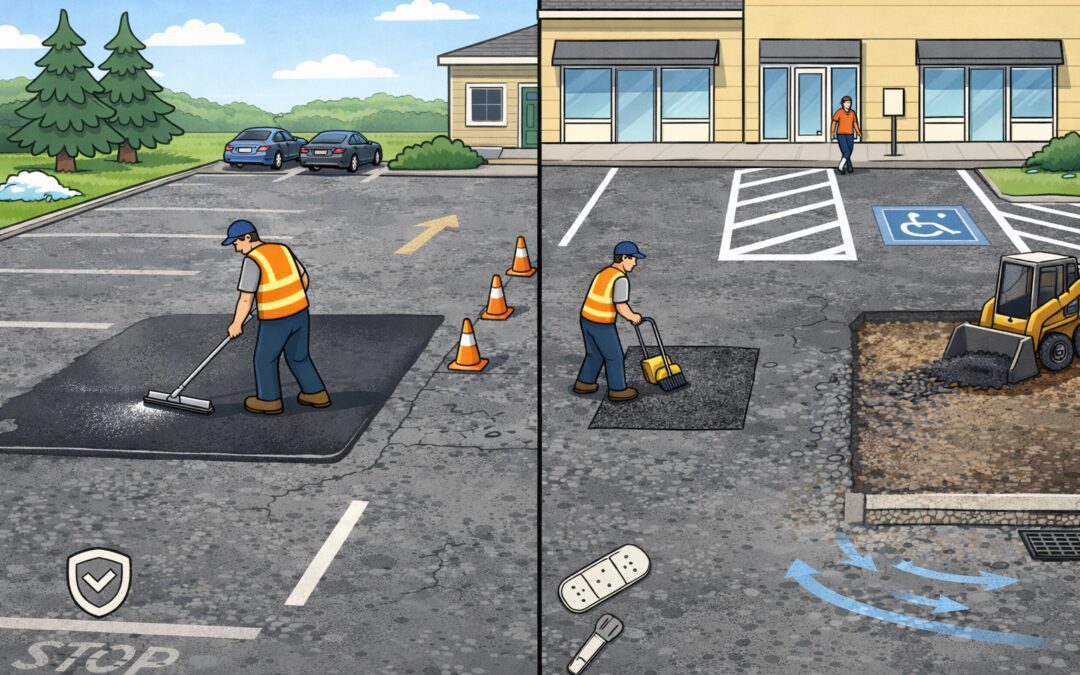
Parking lot care works best when you treat it like triage. Some lots only need a protective coat. Others need targeted repairs in the failing areas first. And sometimes the smartest budget move is to stop spending on short fixes and rebuild the problem areas for good.
If you manage a retail plaza, a clinic, or a busy office site, the goal is simple: keep the lot safe and usable while you spend money in the right order. This guide explains when parking lot sealing is the right tool, when patching is worth it, and when replacement pays off. You will also learn how to compare scopes, plan around tenant hours, and avoid spending on surface fixes when water and base issues are driving the damage. If you are trying to reduce slip hazards, claims risk, and emergency patch calls, this triage approach helps you spend once, not repeatedly.
When Parking Lot Sealing Is the Right Tool
Parking lot sealing is a protective treatment, not a repair for structural failure. It helps the surface shed water and slows oxidation on asphalt that is still in decent shape. If your lot is mostly intact, with light cracking and normal wear, sealing can be a cost-effective way to extend service life.
Before you seal, confirm the basics. Water should drain off the pavement and away from the edges. Catch basins should be working, and low spots should be corrected. Cracks should be filled, and potholes repaired before coating. If your lot has widespread alligator cracking, pumping, or soft spots that return after rain, sealing will not deliver much value until the base issues are addressed.
A good rule is to seal early, not late. Pavement preservation guidance emphasizes applying the right treatment to the right pavement at the right time, so you keep good pavement in good condition instead of waiting for it to fail. For an overview of that approach, see the Federal Highway Administration’s FHWA pavement preservation overview.
When to Patch and Why
Patching is the right tool when failures are localized, and safety is the priority. Think potholes, broken edges at drive lanes, failed utility cuts, or areas where delivery trucks have pushed the surface past its limits. The key is that a real patch is not just “fill the hole.” It is a small rebuild.
For durable patching, crews usually saw-cut a neat perimeter, remove the failed material, and rebuild the base in compacted lifts before placing new asphalt. That process restores structure, improves drainage in the patched area, and reduces the chance the repair will pop out after freeze-thaw cycles. Patching also lets you fix trip hazards, stop water from pooling at broken edges, and keep traffic moving while you plan bigger work.
Budget-wise, patching makes sense when you can contain the problem. If the same potholes return every spring, or if patching keeps spreading across the lot, that is a sign you may be treating symptoms. At that point, it is worth stepping back and evaluating whether base failures or drainage patterns are driving the damage.
When Replacement Pays Off
Replacement is the right move when the lot is failing in a repeating pattern, not a few isolated spots. If large areas are cracked through, edges are collapsing, and patches are everywhere, you may be paying high annual maintenance without improving the underlying condition. Replacement work can also be justified when drainage needs redesign, grades need correction, or you need to reconfigure traffic patterns and parking counts for a safer flow. It is also common when long cracks mirror weak subgrade or repeated utility cuts.
In many cases, “replacement” does not mean tearing out the entire site at once. You can rebuild by zones, focusing first on the worst sections and the highest stress areas like entrances, turning lanes, and loading zones. A phased replacement plan can reduce disruption, protect tenant access, and spread the budget across seasons without sacrificing quality.
Getting Comparable Bids When You Search Paving Services Near Me
When you search for paving services near me, a common risk is comparing bids that do not describe the same work. To get apples-to-apples quotes, ask each contractor for a written scope that specifies the treatment type, whether base repair is included, and any required prep work. For sealing, that means crack work, patching allowances, and cleaning standards. For patching, it means saw-cut depth, base rebuild steps, and compaction expectations. For replacement, it means thickness, mix type, drainage corrections, and how the phases will keep access open.
Also, confirm what is included around traffic control, cleanup, and striping. A scope should state what reopens each day, what stays closed, and what signage is used.
A clear scope helps you budget now and plan next. This is especially helpful when you search for paving services near me and receive wildly different price ranges. It also helps you avoid paying for surface treatments where the base is already failing.
Free plan with cost ranges
If you want a practical plan, start with a site walk and a written phasing recommendation. Review our Commercial Paving page, learn more about our owner-on-site, four-generation approach on About, and contact us to schedule an assessment.